Fernway Journeys: a travel magazine you can book
A 16-page website for Fernway Journeys, a small-group tour company: Japan's Kumano Kodo, Peru's Inca Trail, Morocco from the Atlas to the Sahara. It reads like a travel magazine, because people who spend thousands on a trip read slowly and compare carefully.
Live · 16 pages · English · Design, development & SEO by Shahin Alam
- Industry
- Small-group tours
- Market
- Worldwide
- Language
- English · USD
- Role
- Research, design, development & SEO
- Year
- 2026
- Pages
- 16 pages, clean URLs
- Layout style
- Editorial magazine
- Typefaces
- Instrument Serif + Instrument Sans
- Stack
- HTML · CSS · vanilla JS · Motion
- Structured data
- TravelAgency · TouristTrip · Offer · Service · FAQPage · HowTo
- Devices
- Phone, tablet & desktop
The brief
What a website in this industry has to do, and how this one does it.
Slow, careful buyers
A small-group trip costs thousands of dollars, and people read before they book. So it reads like a magazine, with a standfirst, long captions and journal articles instead of pop-ups.
Group size is the promise
Groups are capped at 12 travellers with local leaders. Every trip shows its days, group size, activity level and from-price up front.
Two ways to travel
Set-departure small groups and tailor-made trips, with a dark band that explains tailor-made planning in four steps.
Answers for AI search
Journal articles answer real questions (what a small-group tour is, how to choose an activity level, tailor-made or group), and the FAQ data is built from the visible text.
Design direction
An editorial travel magazine on paper, ink and an ember accent, with deep forest green for dark sections. Corners are square, rules are hairline, and sections carry numbered overlines ("N° 01 · Japan") and small-caps metadata.
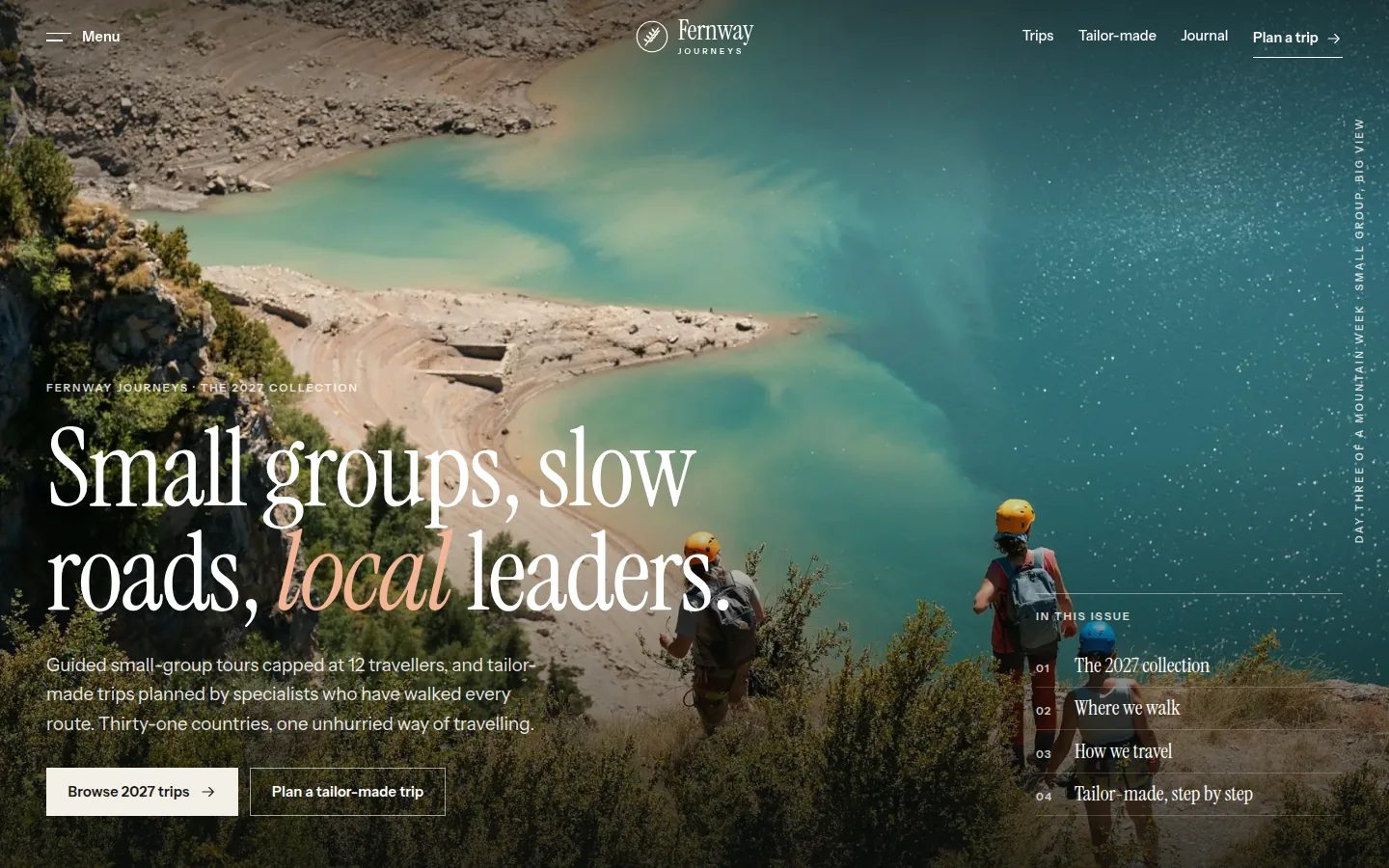
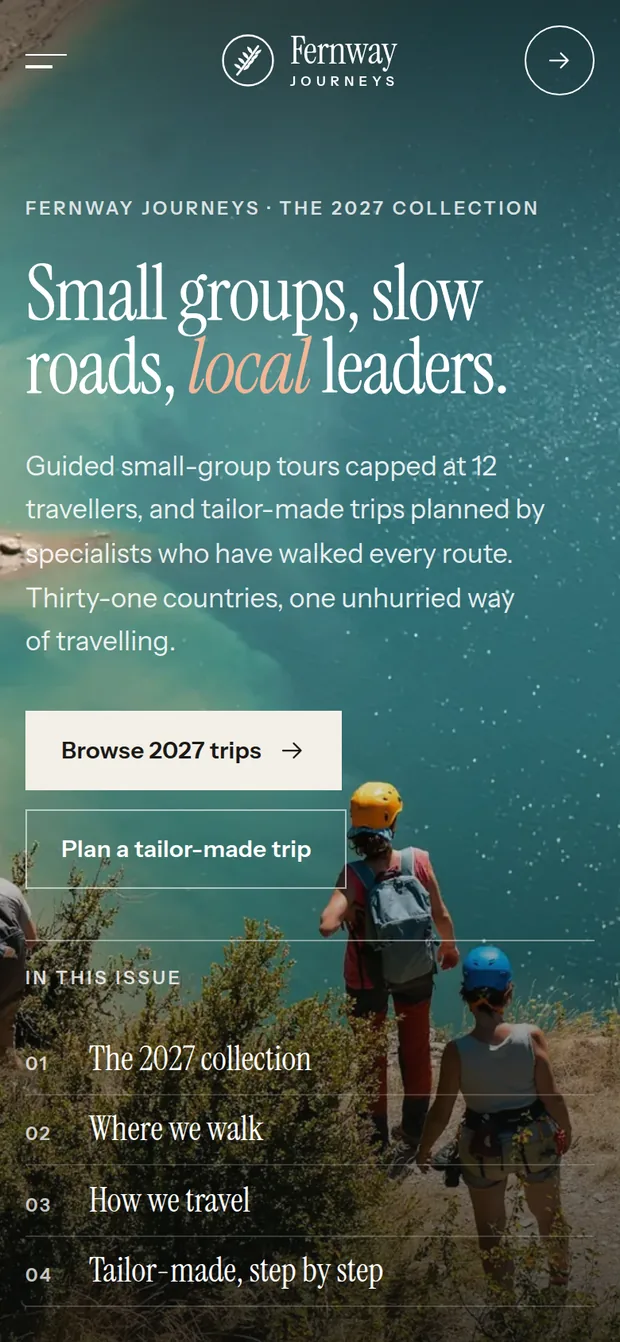
The hero is a full-bleed photo with a huge Instrument Serif headline anchored bottom-left, a vertical location caption like a photo credit, and an "In this issue" contents list. A Menu button opens a full-screen overlay at every screen size, and the footer is a giant wordmark.
Motion. Cinematic and slow (0.9–1.2 s) with no bounce: headings reveal line by line behind a mask, images open with a clip-path wipe, and the rail's progress line follows the drag.
Palette
- Paper
#F3EFE7 - Ink
#1A1916 - Ember
#C2562B - Forest
#233B2E - Sand
#E6DCCB
Type
- Display
- Instrument Serif
- Text
- Instrument Sans
The collection
What it does
Full-screen menu
A dialog menu with staggered links, at every screen size.
Magazine feature grid
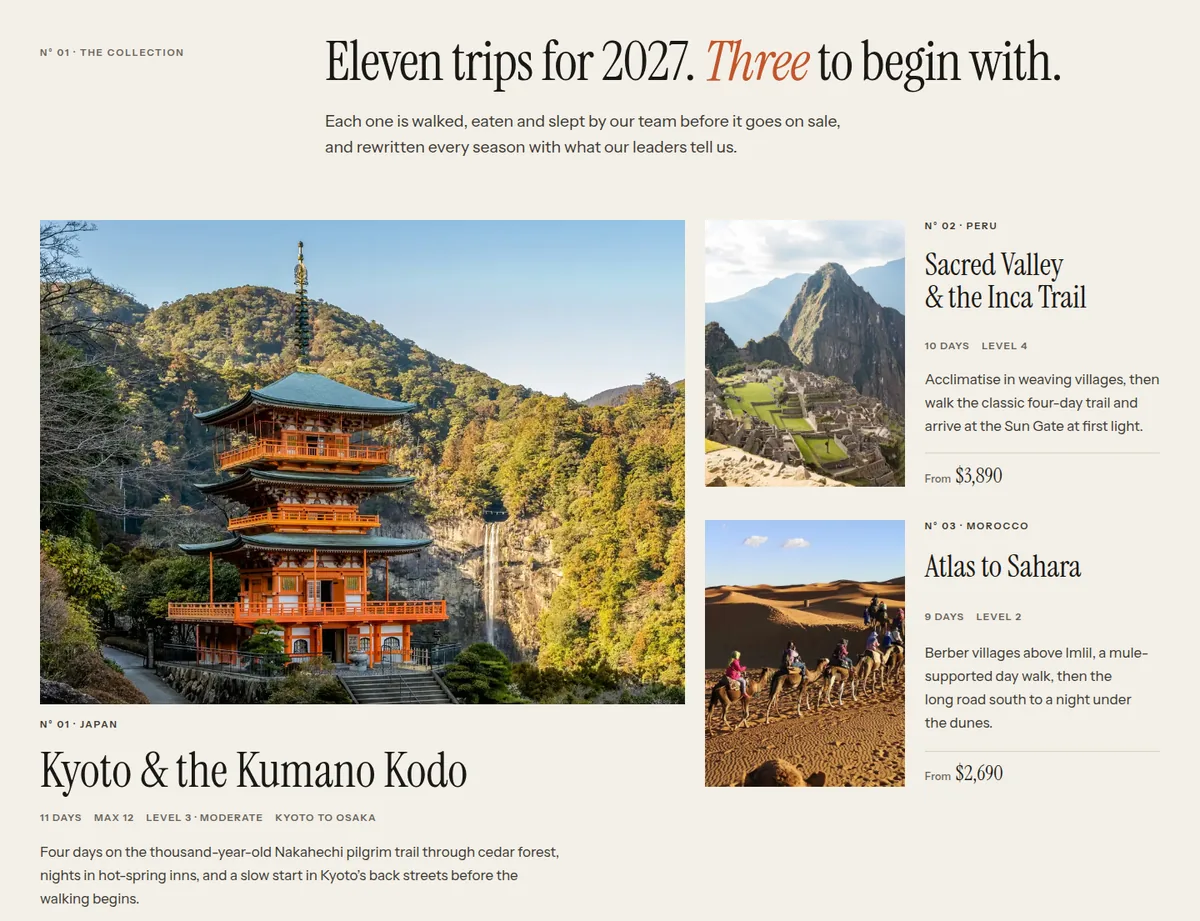
One lead trip across seven columns, with two trips stacked beside it.
Drag-scroll rail
Eight more destinations on a rail you can drag, with a progress line.
How we travel
A sticky split: the image stays pinned while four rules scroll past.
Trip filters
Filter trips by travel style through shareable
?style=links.Pre-filled enquiries
"Enquire" on a trip opens the form with that trip already chosen (
?trip=).Three trip pages
Japan's Kumano Kodo, Peru's Inca Trail and Morocco's Atlas to Sahara.
Tailor-made band
A dark forest section with the four steps of planning a private trip.
Journal
Articles set as magazine rows rather than cards.
Search: SEO, AEO & GEO
How the site is built to rank in Google, answer questions directly and get cited by AI assistants.
- Pages in the sitemap
- 16
- Pages with JSON-LD
- 16
- FAQ answers marked up
- 46
- AI crawlers welcomed
- 13
SEO
Ranking in Google
Trip pages are titled the way people search: "Kumano Kodo Small-Group Walking Tour, 11 Days", "Inca Trail & Sacred Valley Group Trek, 10 Days", "Morocco Atlas to Sahara Small-Group Tour", with canonical and hreflang tags on all 16 pages.
AEO
Answer-first content
Journal articles answer questions directly: "What Is a Small Group Tour, and Is It Worth It?", "How Fit Do I Need to Be?" and "Tailor-Made Trip vs Small Group Tour". 46 FAQ answers on booking, fitness and money are marked up.
GEO
Cited by AI assistants
TravelAgency, TouristTrip and Offer schema for every trip, an llms.txt summary and 13 AI crawlers welcomed by name in robots.txt.
Searches it targets
How it's built
- Page front matter and shared includes keep the trip data, header and footer consistent on all 16 pages, with JSON-LD built from what each page shows.
TouristTripandOfferdata for every trip, andFAQPagedata generated from the visible questions.- A QA check covers every internal link, asset and anchor, one
h1per page, canonical URLs, title and description lengths and image alt text. - Every page works without JavaScript, and visitors who ask for reduced motion get a calm, static page.
Fernway FAQ
Who designed and built the Fernway Journeys website?
Shahin Alam, a full-stack software engineer in Dhaka, Bangladesh, designed and built the Fernway Journeys website in 2026: the research, the design, the front-end code, the structured data and the search setup for all 16 pages.
What is the Fernway website built with?
Hand-written HTML, CSS and vanilla JavaScript with Motion for animation, generated into 16 static pages by a custom build step. There's no framework and no CMS, and every page works without JavaScript.
What are the main features of the Fernway website?
Its main features are: Full-screen menu, Magazine feature grid, Drag-scroll rail, How we travel and Trip filters.
How is the Fernway website optimised for Google and AI search?
Every one of its 16 pages has a canonical URL, one h1, an Open Graph image and JSON-LD (TravelAgency · TouristTrip · Offer · Service · FAQPage · HowTo). 46 FAQ answers are marked up, the guides are written answer-first, and an llms.txt summary plus a robots.txt that welcomes 13 AI crawlers by name help assistants such as ChatGPT, Claude and Perplexity find and cite it.
Is there a related website to Fernway?
Yes. Swapnojatra Tours serves the same industry for a different audience (Dhaka, Bangladesh, Bangla · prices in taka), with its own design.
Where can I see the Fernway website?
It's live at fernway.shahinkhan.online. It works on phones, tablets and desktops.